Are light exercises at home actually effective? To start with the conclusion: consistency is more important than intensity. You can significantly improve muscle strength and cardiovascular function just by moving your body in your daily life, without needing a gym membership or expensive equipment. Today, we will look at specific ways to turn your home into the most efficient workout space.
Many people associate 'exercise' only with high-intensity training that leaves them drenched in sweat. However, for modern individuals lacking physical activity, doing 15 minutes of light stretching or bodyweight exercises consistently is far more effective. In particular, creating a routine that stimulates muscles without straining joints can help you achieve two goals: injury prevention and increased vitality. Regular movement facilitates metabolism and contributes to lowering cortisol, the stress hormone. The reason we choose to exercise at home is that it allows us to care for our bodies anytime, free from time constraints. By breaking exercise into 10-minute sessions after work or right after waking up, you can experience significant physical changes in the long term.
Starting Light Exercise: Stretching and Bodyweight Calisthenics

The most important thing when starting to exercise is to release tension in your body. Stretching goes beyond simply lengthening muscles; it aids blood circulation and increases the range of motion in your joints. The easiest movements you can do at home include reaching for the sky, neck rotations, and twisting your waist from side to side. Investing just 5 minutes right after waking up can completely change your daily condition. In particular, gently relaxing muscles that have stiffened overnight increases blood flow, facilitating oxygen supply to the brain.
The key to bodyweight calisthenics is utilizing your own weight. Squats and lunges are excellent lower-body exercises, but if you have knee issues, you should start with half-squats while holding onto a chair. Wall push-ups are also a very safe and light exercise that stimulates chest and shoulder muscles. What matters is accurate form, not the number of repetitions. Make it a habit to check in a mirror whether your form is correct. Simply checking if your shoulders are hunched or if your lower back is excessively arched can improve the quality of your workout. It is important to focus on each movement and feel the contraction and relaxation of the muscles. Rather than rushing to hit a target number, verifying that the target muscle is being properly stimulated is the shortcut to preventing injury and maximizing workout efficiency.
Strategies for Maintaining Muscle Strength and Increasing Basal Metabolic Rate
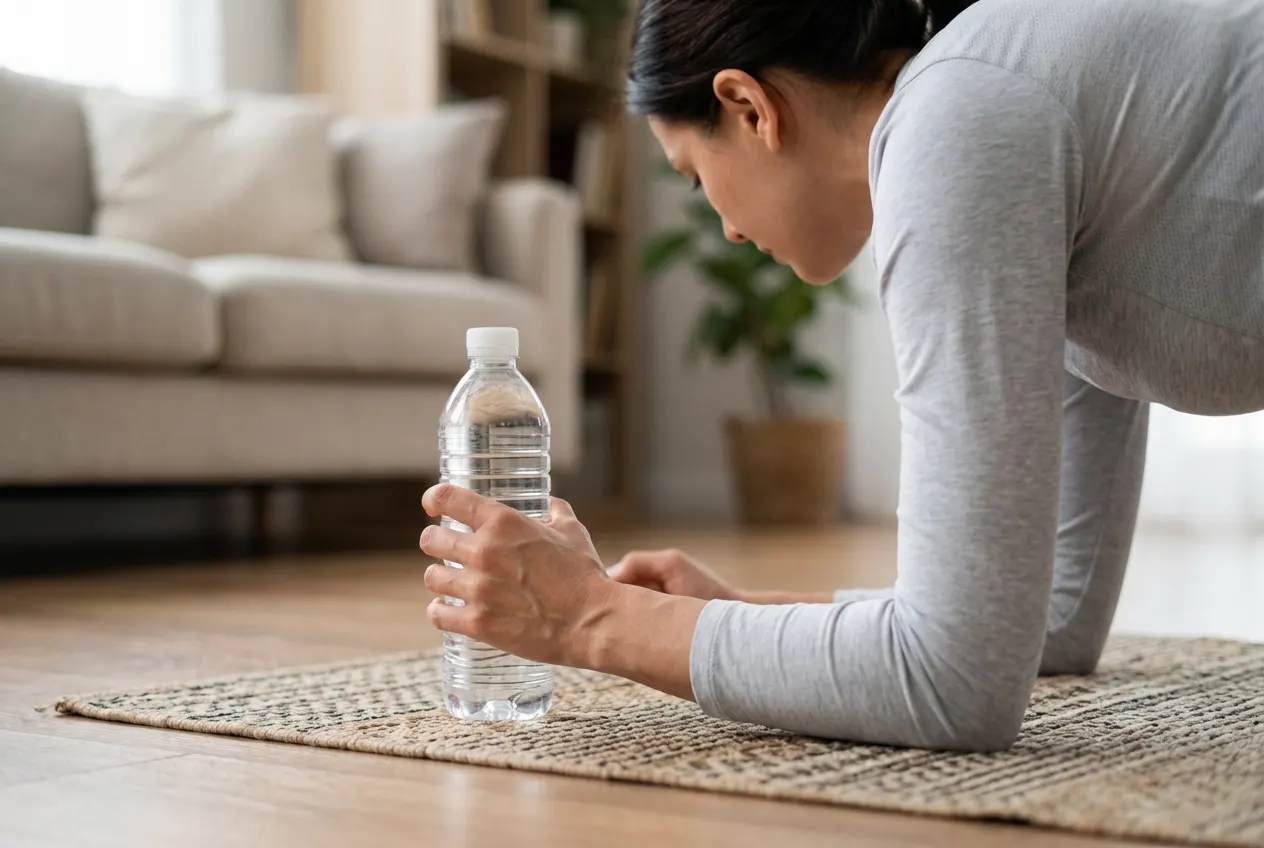
If you want to go beyond simple movement and increase your basal metabolic rate, you need to provide appropriate load to your muscles. Instead of light dumbbells, try using 500ml water bottles you have at home. Simply bending and extending your arms can sufficiently stimulate your biceps and triceps. The key to light exercise is to increase muscular endurance by increasing the number of repetitions rather than the weight. Gradually increasing resistance induces muscle growth and strengthens muscles around joints, which helps prevent everyday injuries.
Planks are very effective for strengthening full-body muscles. It might be difficult to hold for even 20 seconds at first, but try increasing the time by 5 seconds every day. You will be able to feel your abdominal and back muscles becoming firmer. Once your core muscles are stable, the fatigue you feel in daily life will naturally decrease. The key during core exercises is not to hold your breath. Maintaining diaphragmatic breathing helps keep abdominal pressure constant, which is a great help in protecting the spine. When doing strength training, your muscles also need time to recover. Rather than doing high-intensity work on the same body part every day, consider a split routine, such as focusing on the lower body one day and the upper body and core the next.
How to Create an Environment to Maintain a Workout Routine

Because the home is often perceived as a place for rest, people often postpone exercise. To prevent this, it is a good idea to designate a specific workout space. Just laying out a mat in one corner of the living room can send a signal to your brain that 'it is now workout time.' The act of unrolling the mat itself becomes a powerful trigger to start exercising. Separating the space helps with psychological transition. Keeping workout equipment in a visible place rather than in a corner of a room is also a good way to naturally remind yourself to exercise.
Choose a time when you are least fatigued. If after work is too difficult, finding your own time, such as 10 minutes in the morning or during lunch, is key. Overly ambitious plans are a cause for giving up. Start with a light heart, thinking, 'I'll just do 10 minutes.' After finishing your workout, praising yourself and recording your sense of achievement is a great help for long-term motivation. Just marking your calendar as 'workout complete' helps your brain form a reward system, making it easier to accept the next day's workout. Small achievements add up to create big habits. Also, simply changing into workout clothes before starting can have the effect of switching into 'workout mode.' Try the small change of wearing dedicated workout gear rather than exercising in your daily clothes.
Checkpoints and Safety Rules to Keep in Mind
The thing to be most wary of when exercising alone at home is excessive movement. Following high-difficulty moves without expert guidance carries a risk of injury. In particular, if you feel pain in your lower back or knees, you should stop the movement immediately. The lighter the exercise, the more important it is to maintain correct breathing and posture. Repeated exercise while your body alignment is compromised can actually put unnecessary pressure on your joints.
Also, check your condition before and after exercise. On days when you are sleep-deprived or under severe stress, you need the flexibility to lower the intensity. Exercise for health should not end up harming your body. If you have underlying medical conditions or physical discomfort, please be sure to consult with an expert before choosing movements that suit you. It is essential to raise your body temperature with a warm-up before exercise and relieve muscle fatigue with a cool-down stretch afterward. A 5-minute light walk in place or shaking your arms and legs is sufficient for a warm-up. A cool-down helps gradually lower the heart rate increased after exercise and relieves muscle tension, which plays a role in reducing muscle soreness the next day.
How to Make Light Exercise More Enjoyable
If monotonous exercise is boring, try using your favorite music or podcasts. Playing a video you like and following along is also a method. Recently, you can easily access various home training content through YouTube. However, do not try to blindly follow the speed of the instructor in the video; adjust it to your own breathing. Trying to match someone else's pace is a shortcut to injury. Remember that you are the person who knows your own body condition best.
It is also good to find someone to do it with. You can exercise with family or verify your workouts in an online community. The feeling of being with others is a great help in maintaining willpower. The habit of keeping records is an excellent indicator to check how much you have grown after time has passed. Writing a workout log is also a great help in overcoming plateaus. When writing in your log, rather than just writing 'exercised,' try writing specifically, such as '3 sets of 20 squats successful, condition good.' As these records accumulate, you will feel a great sense of pride when looking back on yourself later.
The last point I want to emphasize is that consistency is better than perfection. Skipping a day does not mean you have failed. You just need to unroll the mat again the next day. Light exercises you can do at home are like a lifelong friend. Invest 10 minutes for yourself starting today. Your body will surely reward you with that much vitality. Exercise is a certain investment that goes beyond just grooming your appearance, enhancing mental health and quality of life. Most importantly, move joyfully with a heart that cherishes your body. On days when your body feels heavy, stretching alone can be a sufficiently meaningful time. Why not get up from your seat right now and move your body lightly?
Frequently Asked Questions
What are good exercises for beginners to start at home?
We recommend starting with light stretching to loosen your joints, followed by bodyweight exercises like half-squats using a chair or wall push-ups.
How much exercise is appropriate per day?
It is good to start short, around 10 to 15 minutes at first. What is more important than intensity is the habit of practicing consistently at the same time every day.
What should I do if I feel pain during exercise?
If you feel sharp pain in your joints or muscles, you should stop immediately. Pain is a signal from your body, so do not push yourself; modify the movement or take a rest.
Can I see results even without workout equipment?
Yes, it is fully possible. Bodyweight exercises using your own weight are very effective for muscle strengthening, and you can also add light resistance exercises using items like water bottles.